
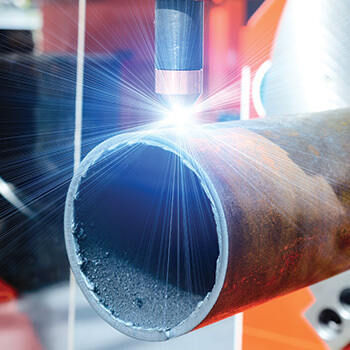
Plasma Arc Welding (PAW)
Plasma arc welding, or PAW, is similar to GTAW, but it uses a smaller arc and lower voltages which increase the precision of the weld. This precision and voltage allows the use of this process to assemble delicate and heat sensitive devices, such a microchips and medical devices.
The torch can also achieve very high temperatures in small spaces. Gas is pressurized inside the wand, creating plasma. The plasma is then ionized, making it electrically conductive. This allows the arc to be created, producing incredibly high temperatures that can melt the base metals. This allows plasma arc welding to be performed with no filler metal, a similarity it shares with TIG welding.
5 Perfect Plasma Arc Welding Applications
- Steel Tubing – An indispensable application for the automotive industry, steel tubing represents a major part of an automotive exhaust system, as well as some chassis structure.
- Welding Small Metal Components – the combination of small arc, low voltage and high-precision lends itself well to assembling micro components.
- An excellent weld for accurately filling butt joints.
- Welding Thin, Electronic Chips – Heat build-up is an enemy of electronics. By lowering voltages and keeping the arc small, heat spread is reduced.
- Medical Device Manufacture – The high precision of plasma arc welding makes the process suitable for assembling critical life-saving devices.
PAW can be used in a very low current mode, making it a great choice for applications that deal with delicate computer parts. Electronic chips can be sensitive to environmental factors like excess heat, which is why low current is particularly effective in these use cases. While GTAW can sometimes be used, but for highest precision plasma arc welding is the top choice.
Muhammad Anis

Professor of Welding FTUI